Attractiveness
Test
A free attractiveness test. No signup. Your photo never leaves this page.
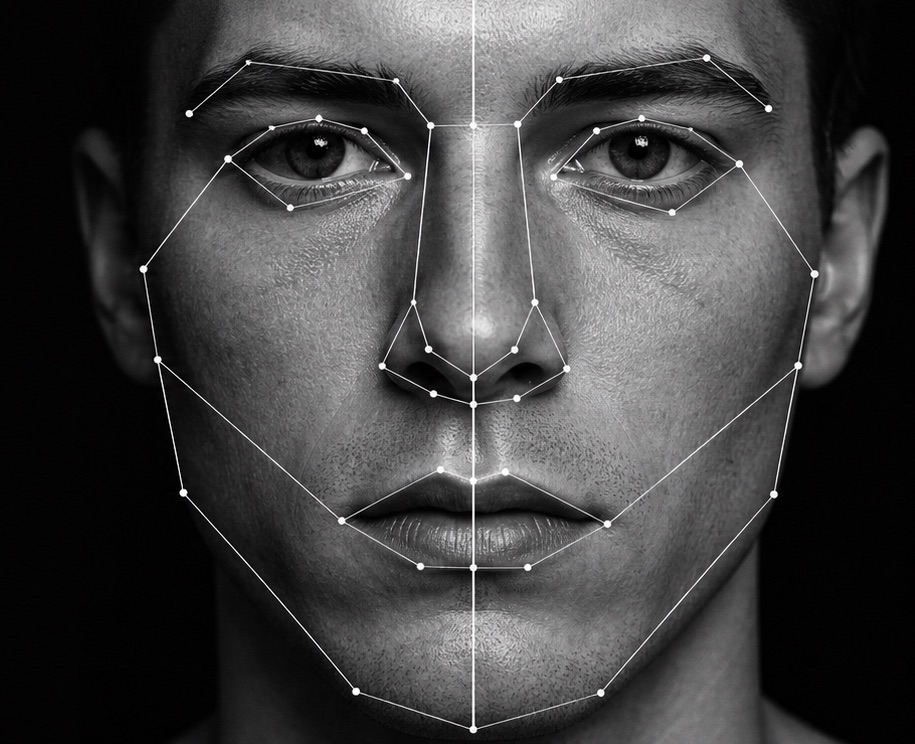
478 landmarks, measured in your browser.
How it works
How this attractiveness test works
01
Check the photo
Lighting, angle, occlusion and sharpness are each graded before anything is measured.
Most tools skip this
02
Measure
Four geometric distances, weighted into one, then read off the distribution. Nothing leaves the page.
478 landmarks · on device
03
Read your position
Where you land on the attractiveness test scale, and what the gap to the next tier is made of.
A position, not a verdict
Photo check
Grade A
- Angle
- pass
- Tilt
- pass
- Distance
- pass
- Resolution
- pass
Harmony
73
- Bilateral symmetry
- 77 out of 100
- Facial fifths
- 48 out of 100
- Vertical balance
- 29 out of 100
- Golden ratio
- 86 out of 100
What you get
Every attractiveness test report carries four things
- A photo grade
- How much of the number is your camera rather than your face.
- A tier and a percentile
- Where you sit, not what you are worth.
- Four components
- Each one checkable against your own reflection.
- Current and reachable
- Built from head angle and tilt only — the two things a retake really fixes.
Sample figures. Your attractiveness test uses your own.
The formula is public
How the score
is calculated
This is the published weighting behind our attractiveness test. It is one documented tradition of proportion, not a universal constant, and we do not present it as one.
| Bilateral symmetry | How closely your left half matches your mirrored right half. | 35% |
|---|---|---|
| Facial fifths | Whether eye width, eye spacing and face width agree. | 25% |
| Vertical balance | Whether midface and lower face divide the height evenly. | 25% |
| Golden ratio | How near three key proportions sit to 1.618. | 15% |
Each component is measured as a distance from its target, divided by how much people actually vary on it. The four are then combined as a weighted root-mean-square rather than averaged, so one component being far off cannot be smoothed over by the other three — those two faces are not equally close to the canon, and an average would call them equal.
Your attractiveness test score is where that combined distance falls among all scans. A 73 means 73% of scans sit further from this canon than you do. It is a position in a population, which is why there is no such thing as a perfect run and why the middle of the scale is so crowded.
Weights sum to 100. They weight the distances, not the score.
Vertical balance compares midface to lower face only. The classical rule of thirds needs a hairline, and the landmark model has no hairline point — guessing one would mean inventing a component rather than measuring it.
The scale
What an attractiveness test score actually means
73
Harmony · Top 27% · above 73% of scans
Most people ask what counts as a good score before they ask what the attractiveness test is measuring. A percentile answers both at once: it says where you sit, and it admits how crowded the middle is.
| Range | Tier | Percentile | What it says |
|---|---|---|---|
| 88–100 | Reference | Top 12% | Close to this canon on all four components at once. |
| 72–87 | Harmony | Top 28% | Strong measured balance, with variation in one component at most. |
| 50–71 | Balanced | Top 50% | Solid across the board. Photo conditions move this more than anatomy does. |
| 28–49 | Distinct | — | A mixed profile. Two components carry most of the distance. |
| 0–27 | Unconventional | — | Outside this canon. That is a statement about the canon, not about you. |
Five classes, not five ranks
Share
Send it as a challenge,
not as a flex.
Nobody forwards an attractiveness test to boast about the number. They forward it to find out who can beat it. So the card carries the score, and the link asks for a rematch.
Harmony
73
Top 27%
- Bilateral symmetry
- 77 out of 100
- Facial fifths
- 48 out of 100
- Vertical balance
- 29 out of 100
- Golden ratio
- 86 out of 100
attractivenesstest.app/r/…
- The photo is optional
- Off by default. Untick it and the card is nothing but numbers — still recognisable as your result, impossible to reverse into your face.
- The link carries five numbers
- A seven-character code holds your attractiveness test score and the four components. No photo, no name, no timestamp — there is physically nowhere in it for those to sit.
- Nothing round-trips a server
- The attractiveness test card is painted on a canvas in this tab and handed straight to your downloads. Watch the network panel while you save it: it stays empty.
Privacy
Nothing is uploaded.
- Landmarks are computed inside your browser
- Only the score is encoded into your link
- No account, no server, no stored image
The whole attractiveness test runs on your device, so there is no retention policy to read — there is nothing held anywhere to delete.
FAQ
Questions people
actually ask
How does this attractiveness test work?
It locates 478 facial landmarks in your browser, fits a midline through the 28 that sit on it, then measures four geometric components: bilateral symmetry at 35%, facial fifths at 25%, vertical balance at 25% and golden-ratio proximity at 15%. Those four distances are combined as a weighted root-mean-square, and your score is where that combined distance falls among all scans. Nothing is sent to a server, and only the resulting numbers are encoded into your result link.
Is this attractiveness test accurate?
It is reproducible, which is a narrower claim. Feed it the same photo and you get the same score every time, and the formula is printed on this page so you can check the arithmetic yourself. What no attractiveness test can do is predict how a particular person will react to your face: expression, voice, movement and familiarity all matter more in a room, and none of them survive in a still photo.
What score is average on this attractiveness test scale?
Exactly 50, because the score is a percentile by construction rather than a mark out of a hundred. That is also why we draw the whole distribution instead of handing you a bare number: the middle is genuinely crowded, and a few points either side of 50 separate faces that are geometrically almost identical. The 1-to-10 scale most attractiveness test sites use has drifted badly, since people call each other a 7 out of politeness, so a mathematically average 5 now reads as an insult. Percentiles do not have that problem.
Does my photo get uploaded anywhere?
No. The whole attractiveness test runs in your browser and the image never leaves the page, so there is no upload endpoint and no stored copy to delete. The only thing that travels is your score, packed into a seven-character result link. Even the share card is drawn on your own device and saved straight to your downloads — ticking “include my photo” changes what that local file looks like, not where it goes.
Why did my score change between two photos of me?
Because the measurement describes the photo, not your skull. Head rotation is by far the largest factor: six degrees off axis fabricates more asymmetry than most faces actually have, which is why past nine degrees this attractiveness test refuses to give a number at all. A raised or tucked chin is next, and it is the more dangerous of the two because it shifts vertical balance in one predictable direction rather than adding noise. That is what the photo grade at the top of every result is for. Compare two scores only when both photos graded the same.
Can I improve my score?
The reachable number we show you is built from two things and no more: squaring up to the camera, and levelling your head. Both are measured in degrees on your own photo, so you can verify the claim by retaking it. Skeletal asymmetry is listed separately as plus or minus zero rather than folded into the total, because selling back a number that adult bone cannot reach is the cheapest trick in this category. No facial exercise moves bone, and any attractiveness test implying otherwise is selling something.
Can I share my result without showing my face?
Yes, and that is the default. Every attractiveness test card carries your tier, your score and your four components but no photograph, and it is drawn on a canvas in your own browser before you ever see it. Your face appears only if you tick the box yourself, and even then the file stays on your device. The link you send out holds seven characters of encoded score and nothing else.
Whose idea of beauty is this attractiveness test measuring?
One specific tradition. The proportion targets come from Western anthropometry and cosmetic-surgery literature, which carry documented Eurocentric bias, so faces from other populations can land lower without being less attractive to anybody. That is why the bottom tier is called Unconventional rather than something worse: the number describes distance from a canon, and the canon is the thing with the limitation.
One photo. Nothing leaves this page.
Take the
attractiveness test
Start the attractiveness test →Free · No signup · No upload · 478 landmarks measured in your browser